"Workplace feedback expert" —Harvard Business Review. I'm a professor at Penn State on a mission to build feedback literacy for all. Nearly 10,000 students in my poetry class. 2,000+ leaders attended my feedback webinar with Harvard. Each week, 3MR offers a reframe to help you live with more clarity and courage.
3MR: Activate Your Mirror Neurons
|
This week's reframe is about growing by observing. Episode Transcript The Seeking Feedback Observe card states, "Feedback isn't always direct and verbal. Observing rather than only admiring someone who is excellent at something can be an effective way to grow." And the card invites you to practice what's called the micro-mapping, which you can do by finding someone with a skill you admire, mapping out the many behaviors that form their style, and then asking yourself, which will you practice first and why? Let's dive into this one. Many studies show that actively observing excellence, really studying it, can function as a form of feedback that helps people improve. Researchers call this action observation, the intentional practice of watching high-level performers as a way to activate the brain's mirror neuron system. Think of it as the neurological equivalent of a dress rehearsal. Research suggests that for athletes, for example, repeated observation can trigger some neural changes nearly identical to physical practice. In one study, inexperienced golfers improved their putting simply by watching experts. In another, youth gymnasts achieved higher ratings after a period of focused observation. But here's the key word: focused. The point is not to get enthralled. This is not watching for entertainment, and it is certainly not passive. In our video age, it's easier than ever to sort of check out while a screen plays in front of us. Active watching is different. It means noticing the minute details, maybe writing about them. If it's a video, it means rewinding to catch a single movement, playing it again and again until you understand what's actually happening. Decades ago, when I lacked access to a Brazilian jiu-jitsu gym, I spent hundreds of hours studying videos from elite practitioners. I wasn't just watching them. I was attempting to inhabit them, seeing every subtle move they made. I looked for the invisible details, the exact timing of a breath, the micro adjustment of a hip, the way weight was distributed before a transition. By the time I finally stepped onto the mat to practice, I didn't feel like a novice when practicing what I had studied. I felt like I had already completed twenty-five percent of the work. Now it was just about putting the repetitions in so my body could catch up to what my brain already had a sense of how to do. I call this the observational on-ramp. The on-ramp ensures that when you finally move into practice mode, you aren't wasting energy trying to figure out what the behavior is or how the mechanics work. Your brain already knows a good part of the map. Your body just needs the massive reps so it can walk the trail. That's card 04 of the Seeking Feedback suit. Pick someone excellent at a thing you want to improve. Study them the way you'd study a map before a journey. You may find that when it's your turn to practice or perform, part of you has already been there.
|
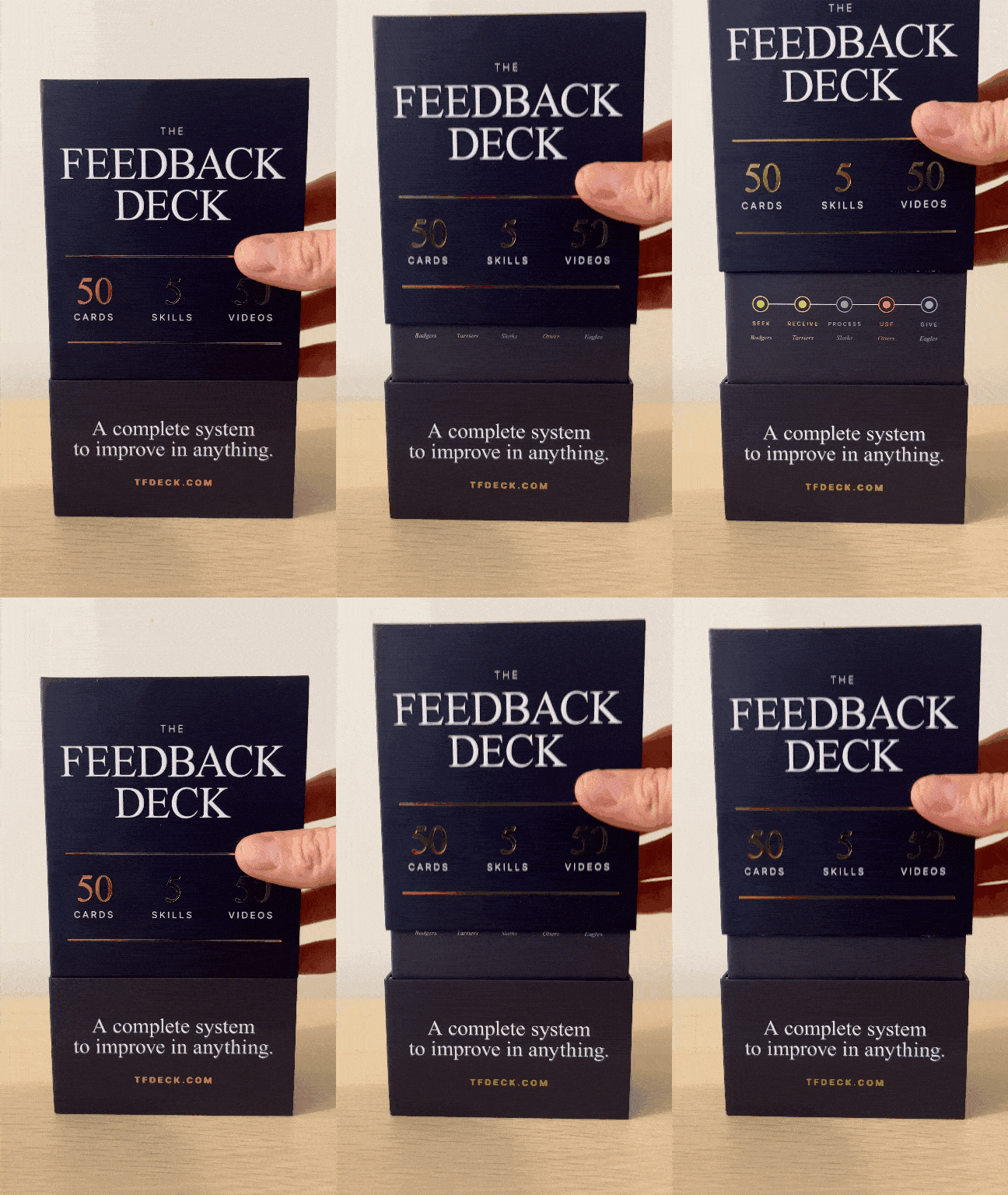
3-Minute Reframe
"Workplace feedback expert" —Harvard Business Review. I'm a professor at Penn State on a mission to build feedback literacy for all. Nearly 10,000 students in my poetry class. 2,000+ leaders attended my feedback webinar with Harvard. Each week, 3MR offers a reframe to help you live with more clarity and courage.
Not curating your growth is still curating. Here's how to apply strategy. Click to watch on YouTube Episode Transcript The Processing Feedback Filter card states, "You are the curator of your own growth. Not every piece of data belongs in your museum. Separating what matters from what doesn't is a skill." And the card invites you to practice the three bins, which you can do by sorting feedback into mental bins: adopt for what's valid and helpful, adapt for a valid point wrapped in poor...
This week's reframe is an invitation to look at your assumptions. Click to watch on YouTube Episode Transcript The Receiving Feedback Assume card states, "Assuming the giver wants to help can prepare you to listen. If you assume a threat is coming, you may default to defensiveness, which can make learning difficult." And the card invites you to practice what's called adjust the dials, which you can do by dialing down your defenses and dialing up your readiness to learn by thinking, "This...
Fresh off a 37-point game last night, Yaxel Lendeborg is not only soaking up insight wherever he can — he's putting it to use. Watch on Instagram or on Facebook ◆ FeedbackLiteracy The skill that builds every other skill. Seeking · Receiving · Processing · Using · Giving The Feedback Deck $29 / deck 50 evidence-based cards across the five dimensions of feedback literacy. For individuals, teams, and the organizations they power. ◆ 50 cards across 5 suits ◆ 50 companion videos via QR code ◆...