"Workplace feedback expert" —Harvard Business Review. I'm a professor at Penn State on a mission to build feedback literacy for all. Nearly 10,000 students in my poetry class. 2,000+ leaders attended my feedback webinar with Harvard. Each week, 3MR offers a reframe to help you live with more clarity and courage.
3MR: Apple on the Table
|
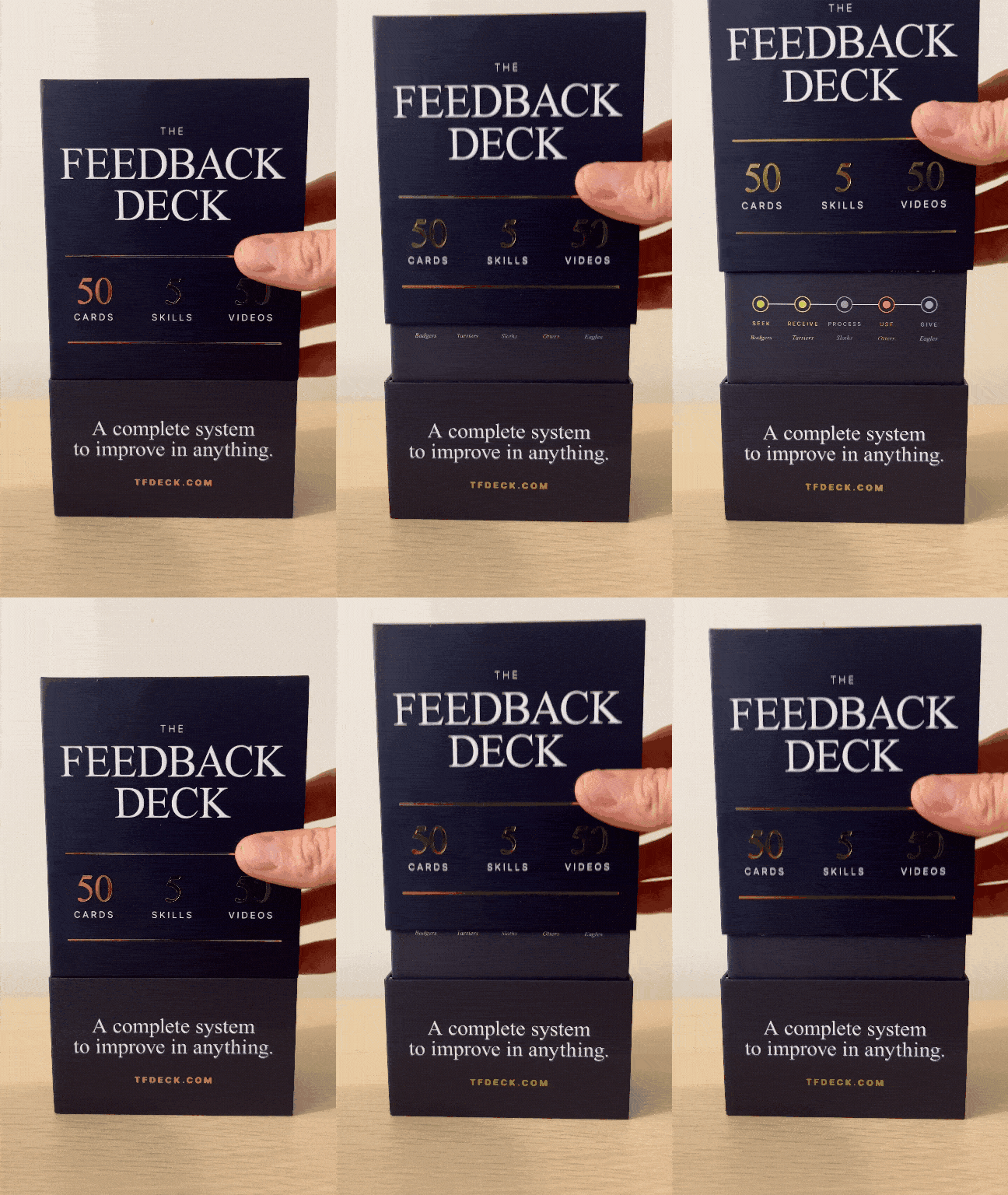
This week's reframe is about separating our core self from our work performance. Episode Transcript The Receiving Feedback Separate card states, "Decouple your identity from your performance. When the two fuse, feedback can feel like a threat to who we are. You are more than your current performance." And the card invites you to practice what's called the object, which you can do by imagining your performance as an object on the table between you and the feedback giver. The feedback lands on it, not on you. Let's spend some time with this one, because perhaps no card in the deck has positively changed people's feedback experiences quite like it. So many of us naturally tangle up our performance at work with our core identity, with the very root of who we are. And in certain societies, this fusion is almost trained into us. Notice how in many places, immediately after we ask someone their name, we ask them what they do, as if what they do is the greatest glimpse we can get into who they are, what matters to them in life, or even the thing we're most interested in learning about them. I don't think the social norm is innocuous, because it does kind of propel an illusion, and it's an illusion with real consequences. Because when we believe that a certain behavior, including a behavior that could use improvement, is not just something we do but is at some fundamental level a major part of who we are, feedback conversations can become terrifying. Getting helpful negative feedback, even when it's delivered well, can feel like an existential threat, an attack on our deepest nature. Our nervous system responds accordingly, and learning becomes nearly impossible in that heightened survival state. This is where the object comes in. Many people, especially those who struggle with this fusion, and I certainly have and many times still do, have found it helpful to imagine something concrete, say a shiny red apple sitting on the table, as they receive feedback. Just imagine the apple. The apple is your performance. It's the thing being commented on. It's a part of you, yes, but it's just a part of you, and it's also separate from the deepest core of who you are. Seeing it as an apple means for some that it can be more easily examined, kind of turned over, improved, and it's exactly this little bit of distance that allows them to see the feedback from a vantage point that feels safer and, importantly, more useful. Because when the feedback is landing on the apple rather than on you, you can actually look at it, consider it, ask questions about it. It might help those defensive parts in you calm down, which can allow you to absorb information better. Here's something encouraging. Even doing this a few times can begin to rewire the pattern. Many people find that after a handful of feedback conversations with the apple and the table thing going on, they no longer need the visualization at all. The separation starts to become how they naturally relate to their performance. That's card 03 of the Receiving Feedback suit. Before your next feedback conversation, try placing your performance on the table. You may find the conversation feels less like a verdict on who you are and more like two people examining something together, because that's what it actually is, or at least should be.
|
3-Minute Reframe
"Workplace feedback expert" —Harvard Business Review. I'm a professor at Penn State on a mission to build feedback literacy for all. Nearly 10,000 students in my poetry class. 2,000+ leaders attended my feedback webinar with Harvard. Each week, 3MR offers a reframe to help you live with more clarity and courage.
Not curating your growth is still curating. Here's how to apply strategy. Click to watch on YouTube Episode Transcript The Processing Feedback Filter card states, "You are the curator of your own growth. Not every piece of data belongs in your museum. Separating what matters from what doesn't is a skill." And the card invites you to practice the three bins, which you can do by sorting feedback into mental bins: adopt for what's valid and helpful, adapt for a valid point wrapped in poor...
This week's reframe is an invitation to look at your assumptions. Click to watch on YouTube Episode Transcript The Receiving Feedback Assume card states, "Assuming the giver wants to help can prepare you to listen. If you assume a threat is coming, you may default to defensiveness, which can make learning difficult." And the card invites you to practice what's called adjust the dials, which you can do by dialing down your defenses and dialing up your readiness to learn by thinking, "This...
Fresh off a 37-point game last night, Yaxel Lendeborg is not only soaking up insight wherever he can — he's putting it to use. Watch on Instagram or on Facebook ◆ FeedbackLiteracy The skill that builds every other skill. Seeking · Receiving · Processing · Using · Giving The Feedback Deck $29 / deck 50 evidence-based cards across the five dimensions of feedback literacy. For individuals, teams, and the organizations they power. ◆ 50 cards across 5 suits ◆ 50 companion videos via QR code ◆...