"Workplace feedback expert" —Harvard Business Review. I'm a professor at Penn State on a mission to build feedback literacy for all. Nearly 10,000 students in my poetry class. 2,000+ leaders attended my feedback webinar with Harvard. Each week, 3MR offers a reframe to help you live with more clarity and courage.
3MR: One Brave Ask Changes a Whole Team
|
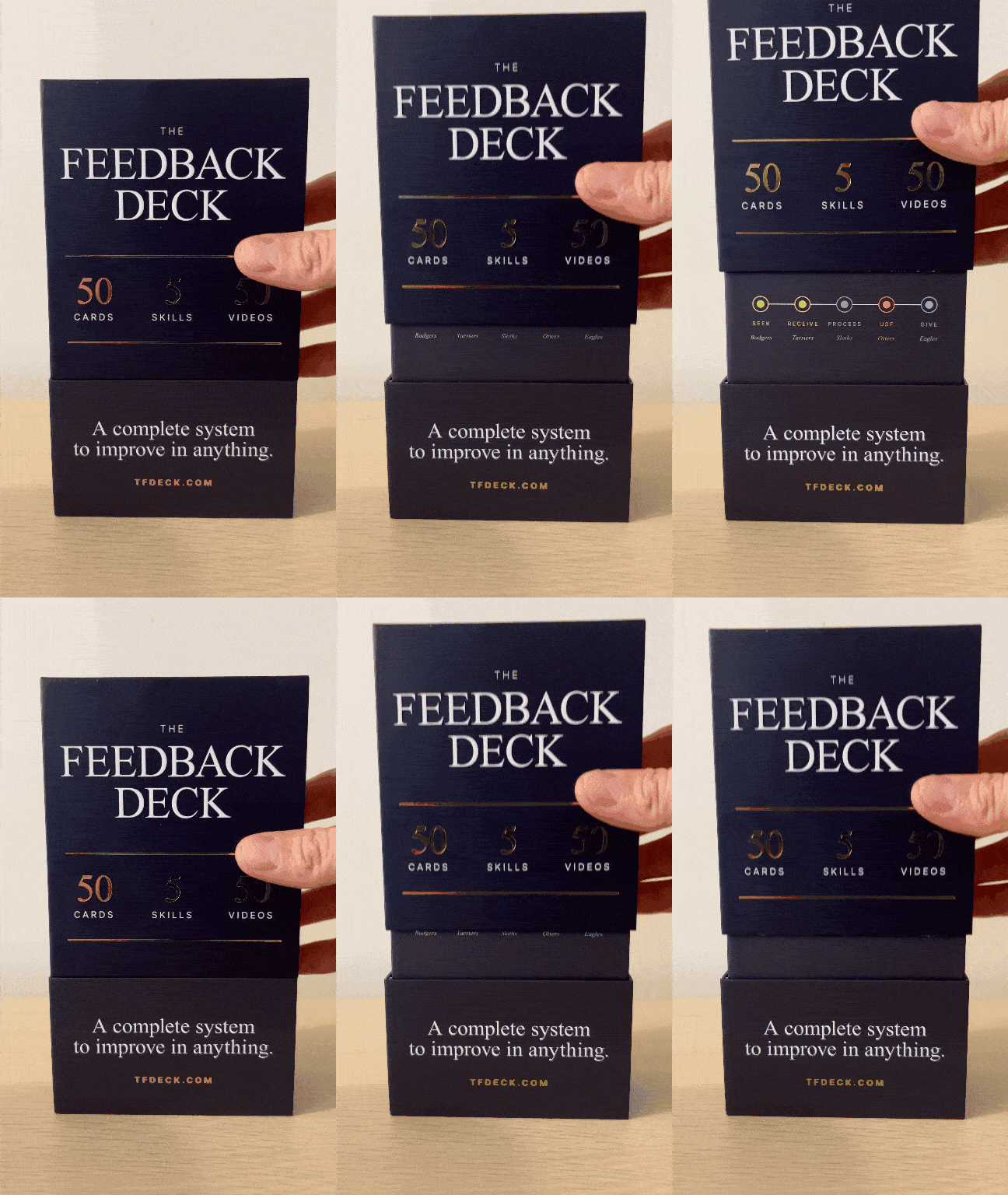
This week's reframe is about the ripple effect of openly seeking feedback. Episode Transcript The Seeking Feedback Modeling card states, "When you seek feedback, it makes it easier for others to do the same. Openly normalizing the vulnerability needed for growth has a powerful ripple effect." And the card invites you to practice what's called the signal, which you can do by asking someone whose opinion you value, "I'm trying to improve my... What specific changes could help?" So building yourself into a great feedback seeker allows you to grow in new and important ways. That much is clear. But something else happens alongside your growth, something most people never consider. You improve the feedback culture you're part of, and this becomes a kind of endless loop. The better you seek, the more others see how you do it, and the less afraid, the more open they become to doing the same. It's like your personal rising tide has the capacity to lift your team, your department, maybe your entire organization. Keep this close, because there are two notions worth breaking through here. The first is that feedback seeking only benefits you. The second is that improving a feedback culture can only happen through changes at the leadership level. Both of those ideas fall apart when you watch what actually happens in a room where one person, any person, asks for feedback with genuine openness. There is an infinite symbiosis between individual courage, that kind of pro-growth modeling, and the collective culture. Every time you seek, you give everyone watching a little more permission to do the same. Now, notice the specificity in the signal: "I'm trying to improve my skill. What specific changes could help?" Underlying that question is real work, self-reflection, an understanding of what you want to improve and why, and a question built to get a specific response. Specific questions are more likely to get specific responses. Vague ones tend to attract politeness, and politeness, while pleasant, rarely helps anyone grow. So this card is really asking two things of you: Do the inner work to know what you're trying to improve, then ask in a way that others can see. Not performatively, genuinely. The vulnerability is the point. When people watch someone they respect openly say, "Here's what I'm trying to get better at," it recalibrates what feels possible for them. That's card 03 of the Seeking Feedback suit. After practicing the signal a few times, you may notice something happening around you, a colleague asking you for feedback, a teammate opening up about a skill they're working on. That's the ripple effect, and it started with you.
|
3-Minute Reframe
"Workplace feedback expert" —Harvard Business Review. I'm a professor at Penn State on a mission to build feedback literacy for all. Nearly 10,000 students in my poetry class. 2,000+ leaders attended my feedback webinar with Harvard. Each week, 3MR offers a reframe to help you live with more clarity and courage.
For decades, the career advice was to become T-shaped: to develop mastery of one domain (the vertical part of the T) and then pair that with a general set of skills (the horizontal part of the T). It was and still is useful advice. But it’s no longer enough. I spent 18 months at Cisco on a project that touched millions of people in 195 countries. The colleagues who moved the project forward weren't the deepest specialists or the broadest generalists. They were something rarer. They had...
In 1924, a psychology professor named Robert Chenault Givler published The Ethics of Hercules, arguing that our ethical values and our bodies should not be studied apart — that our bodies provide important signals that shape our values and our ability to make decisions. It was a radical idea then and still is today in 2026, a time when many of us are told to believe that pure brainpower or AI tools can solve everything. One look around the world’s events and I can’t help but ask: How’s that...
This week's reframe covers when (and why) to state your intent before giving challenging feedback. Click to watch on YouTube Episode Transcript The Giving Feedback Intent card states, "State your positive intent. If the receiver assumes you don't have their best interest in mind, even great feedback may not land well." And the card invites you to use what's called the preface, something like, "I'm sharing this because I believe in what you're doing, and I think one thing could make it even...